
The Jeep Wrangler rattles as it drives up the gravelly, winding, mountain roads of Mount Baldy. Cold air from the open window turns the tips of our noses red and plays with our hair as sunlight peeks through the large pine trees surrounding the car on both sides. Each sharp turn brings us closer to a clearing in the horizon. As the scent of pine and gas fuse with the crisp mountain air, we sing along to the music blasting out of the car’s speakers. Zach Bryan sings “How lucky are we? It’s been a hell of a week, but you’re all grown now…” as we race higher and higher up the mountain in a desperate attempt to catch the sun before it sets. There’s laughter—loud and uncontrollable, the kind that comes from inside jokes you can’t remember who came up with. We notice the road is empty, so we open the sunroof and take turns sticking our heads out of it. It’s reckless, stupid even, but we’ve never felt more alive or free. As the weight of our responsibilities and stress fade into the distance, we feel untouchable. I look at my friends before becoming aware of my heart beating loudly in my chest–not just from the adrenaline of the drive, but from fear. This moment won’t last forever. This time next year I won’t be with the girls I have known since we were seven years old. The road curves once again and the view after the turn renders us speechless. Between two mountain peaks, the sunset illuminates the sky with vibrant yellow, orange, pink, and purple light. We pull over on the side of the dirt road, rush out of the car, shoes crunching against the rocks and dry leaves scattered over the narrow, hidden path as we run up it, ignoring the “private property” sign in our rush. High above the trees, the sunset captivates us. Sitting in a messy line with our shoulders pressed together, we watch the sun dip behind the mountains. No one speaks. I unconsciously hold my breath in an attempt to make time stretch just a little longer. Glancing over at my friends, their faces glowing in the golden hour light, I pull out my phone to capture the ethereal sunset. I want to remember this moment forever, bottle what I feel, and hold onto it when we inevitably become too busy to talk every day. The moon peeks out from behind the clouds–a reminder that it is almost time to go, but none of us move. We know the drive down will feel different–quieter, colder, more real. So, for now, we savor the colors that linger in the sky before darkness envelops us.
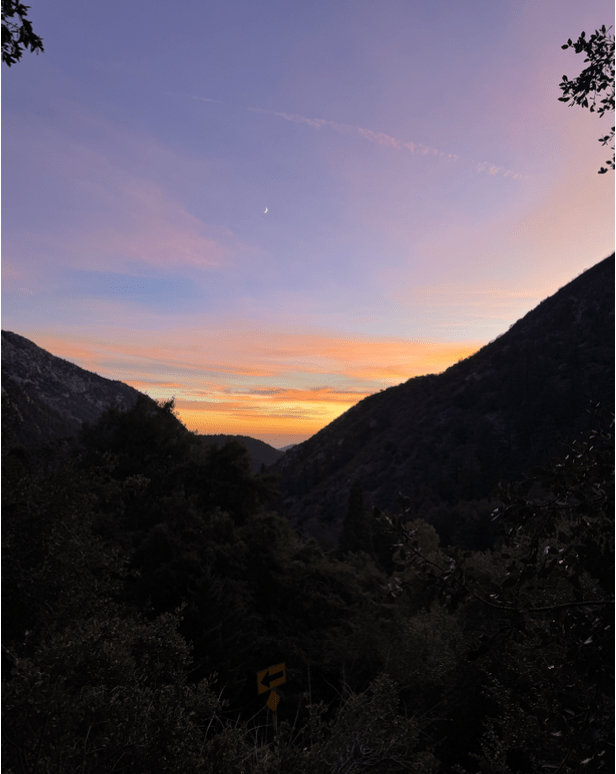
And in that moment, I swear we were infinite.
– The Perks of Being a Wallflower
Sunsets have always felt like a reminder that each day comes to an end. They go beyond the breathtaking colors that light up the sky as they urge us to pause, breathe, and reflect. But why do they prompt this behavior? While all forms of natural beauty are thought to improve a person’s emotional wellbeing, sunsets stand out as moments of peace and happiness (Zhang et al. 2014). The simple act of slowing down to watch the sun set behind the horizon inspires both a mental feeling of contentment as well as the release of dopamine, aka the “feel-good” hormone, in the brain (Psychologs Magazine 2023). Moreover, exposure to natural light relieves stress and helps reset the body’s internal clock, which leads to better sleep (Kim). Not only are sunsets associated with physical well-being, but psychological well-being also lies in an appreciation of nature’s beauty and the feelings it inspires. The feeling of awe is typically difficult to evoke, but feeling it can improve mood and decrease anxiety (Smalley). So, watching the sunset is considered a form of “ecotherapy” or “nature therapy” as it is an “awe-inspiring moment” (Patel). Aristotelian philosophy supports this connection between sunsets and psychological well-being, as the theory of eudaimonia, or human flourishing, represents activities that provide fulfillment instead of superficial pleasure (Zhang). Watching sunsets is an example of savoring—the psychological concept of fully appreciating experiences to amplify their impact. Sunsets require us to slow down and be present with all of our senses, mirroring the benefits of a “daily meditation” (Zhang). The colors move and change, so if you’re not paying attention, you may miss the most breathtaking moments—the sudden burst of pink that appears as the sun dips below the horizon or the shift from blue to black that marks the completed transition to nighttime. But simply being in nature and watching the sun does not automatically improve well-being; rather, an emotional connection to nature and the ability to appreciate its beauty is responsible for this positive impact (Zhang). Sunsets offer more than just a view of the setting sun, they symbolize a collective break from the constant pressures of the day—a time to breathe and reflect (Zhang). People who experience these moments are more likely to engage in prosocial behavior, which is acts of generosity towards others, because they are connected to the beauty around them (Zhang). This translates to being more open to express that connection through empathetic acts.
“Nature does not simply heal the soul by its presence, but by the way it stirs the heart, inviting us to pause, reflect, and recognize the beauty that binds us all.”
–Jia Wei Zhang
The beauty we see in the world encourages us to extend that beauty to others, so sunsets are not only vital for our mental and emotional well-being, but also help foster a sense of connection to the people around us. The act of appreciating nature becomes a collective one that extends to how we care for others. However, this emotional connection with nature, especially in moments like sunsets, is challenging to preserve and share with others.
***
A sense of melancholy suffocates us as we drive down the mountain—the turns sharper and air colder. I open my phone to look at the pictures I captured. The action is automatic—my mind subconsciously racing to decide which picture is the best to post. “Is this one too dark?”
“Yeah…why are the colors so dull? They looked so much more vibrant in the sky.”
A look at any form of social media, such as Instagram or TikTok, will show an endless stream of (heavily edited) sunset photos and videos, which hashtags like #ChasingSunsets or #GoldenHour in the captions (Patel 2023). Sunsets have become an aesthetic fixation as the phrase “chasing sunsets” is used to describe the physical action of rushing to a scenic viewpoint before the sky glows with vibrant pink and orange light—an activity my friends and I participate in often. While the phrase “chasing sunsets” is meant to reflect the beauty of life and living in the moment, it goes beyond a reminder to seize the day (Greene). In many ways, it encapsulates the human experience. The sun rises and sets every single day, regardless of where we are, but the rush of “chasing” it is irreplicable. It not only encourages us to seek out moments that render us speechless, but also reflects the human attempt to cope with the fleeting nature of reality. My friends and I can never truly “catch” the sun; we can only follow the fading light and admire its transient beauty. But as we try to capture these moments, we can’t help but wonder—is it truly living in the moment if we feel obligated to document it? The need to film and share experiences is embedded in the human psyche. More than 86 million pictures are uploaded to just Instagram daily (Green). We crave connection and validation, as if knowing our experiences matter to someone else makes them more worthy (Greene).
***
As I once again find myself on a bluff overlooking the ocean, familiar pink hues lighting up the sky, I instinctively reach for my camera. Stop. You don’t need to take pictures of everything. Enjoy it. The logical part of my brain resists. I wonder if I am ruining the experience by trying to eternalize it. Alas, the fear of regret quickly takes over, and my fingers instinctively find their way to the buttons on my camera.
“Photographs are a way of imprisoning reality… One can’t possess reality, one can possess images—one can’t possess the present but one can possess the past.”
–Susan Sontag, On Photography
Bhagat 5
Taking pictures and posting them onto social media has become an attempt to hold onto a tangible version of reality, but in doing so, it transforms the present into the past (On Photography: Imprisoning Reality…). While taking pictures may allow people to relive the beauty of a sunset, many pictures and videos are rarely revisited. They become digital archives, pictures that sit ignored in the cloud, before being replaced by new memories. The only attempt made to preserve their relevance is to alter their beauty for the gaze of others.
*** “Try adjusting the exposure or contrast.”
“Okay. I don’t know why my phone ruins the lighting.”
I stare at the editing scale bars on my phone. Nothing I do can seem to mimic the colors I saw in the sky minutes ago, but any changes I make to the brightness, saturation, and warmth unsettles me as they make the image look artificial.
Capturing the beauty of a sunset in a photograph is challenging because the camera struggles to reproduce the light and color created by atmospheric scattering. Before we can see it, sunlight travels through the atmosphere and interacts with air molecules smaller than its visible wavelengths (Patel). These molecules scatter shorter wavelengths, such as blue and purple, out of our sight, while longer wavelengths like orange and red pass through easily, creating the vibrant colors of sunsets (Patel). The atmosphere acts like a filter, as it alters the colors we see. Furthermore, the spectrum of shadows to the highlighted, vibrant colors that sunsets encompass makes them a very high contrast natural phenomenon, beyond what a camera sensor is capable of capturing in a single exposure (Glenn). This limitation not only challenges photography but also reveals a deeper reality: cameras cannot fully capture the vivid range and depth of color visible to the human eye, making the true beauty of a sunset irreproducible and deepening the divide between human experiences and what can be preserved.
The inability to capture a sunset on camera often leads to individuals editing their photos before sharing them on social media. Each edited photo contributes to crafting an idealized narrative of their lives—of our lives—rooted in a dependency for validation and appreciation from others (Eg et al.). With every edit made, the disconnect between one’s authentic self and their curated online persona grows larger, leading to feelings of self-doubt, inadequacy, and an increased need for approval (Eg et al.). But why do we feel compelled to manipulate the narratives of our lives? Perhaps we doctor them because, in our desire to grasp and hold onto reality, we find comfort in reshaping it into something that feels more permanent, even if it is only an illusion.
This need to reshape reality goes beyond a pursuit of beauty, it reflects the human desire for fulfillment and meaning in life. Sunsets represent the culmination of a day, a pause before the cycle resumes with the next sunrise. They serve as a small rebellion against the continuous urge to do more—the antithesis of productivity as they require nothing but presence. It is in these moments that worries connected to our reality fade away and we can experience transcendence.
For this reason, the beauty of sunsets continues to captivate both myself and others, no matter how often we see it. In a world obsessed with technology, screens, and what feels like a never-ending need to be productive, sunsets invite us to briefly pause. They command attention without asking for anything in return and unlike the endless feed of social media, sunsets are finite. During the approximately thirty minutes of civil twilight (the brightest phase of a sunset), the colors in the sky change quickly (Dickson). The shift into nautical twilight then brings with it a new set of colors (Dickson). Each phase lasts only a moment and serves as a reminder of life’s ephemerality. When we hit record or take a picture of it, we try to save what cannot be saved—and in that lies the paradox.
While this focus on endings—the end of the day, the end of light, the end of moments—can incite a feeling of melancholy, sunsets remind us of the beauty in life’s endings and beginnings. The sun setting and moon rising represents a life cycle from birth to death in some African cultures as the sunrise symbolizes a rebirth (Kim). For this reason, many people associate sunsets to their deceased loved ones “lighting up the sky with their spirit.” In folklore, they represent the inevitability of change (Kim). Sunsets provide a space for us to project our emotions onto the canvas of the setting sun—embodying the stories we tell ourselves as we chase the fading light.
Chasing sunsets has become a form of self-care for me amidst the chaos of life. Whenever the crushing weight of the expectations placed on my shoulders overwhelms me, I drive back up to Mt. Baldy. This ritual reassures me that no matter how daunting the mountains in front of me seem, the sunset is always visible in-between. Because that night, I realized that the act of chasing sunsets wasn’t really about the sunset itself. It was about the shared experience with my friends and unspoken acknowledgment that life, at that moment, was enough.
Works Cited
Dickson, Christina N. “Beyond Sunset: The Different Phases of Twilight.” Digital Photography School, 4 Aug. 2021, digital-photography-school.com/beyond-sunset-the-differen-phases -of-twilight/#:~:text=Nautical%20Twilight&text=This%20period%20also%20usually% 20lasts,over%20from%20the%20fading%20sun.
Greene, Jasper. “Why Do We Feel the Need to Document Everything? Exploring Our Obsession with Recording.” Medium, 5 Jan. 2023, jaspergreene.medium.com/what-is-our-obsession -with-recording-everything-65d09ca271fc#:~:text=We%20want%20to%20show%20 others,us%20thrive%2C%20grow%20and%20accomplish.
Guy, Glenn. “Sunset Photos: What Could Go Wrong?” Travel Photography Guru, Travel Photography Guru, 23 Aug. 2019, http://www.travelphotographyguru.com/travel-blogs/photographing-a-sunset-beaufort.
Eg, Ragnhild, Özlem Tønnesen, and Merete Tennfjord. “A Scoping Review of Personalized User Experiences on Social Media: The Interplay between Algorithms and Human Factors.” Computers in Human Behavior Reports, vol. 9, 2023, p. 100253, doi:10.1016/j.chbr.2022.100253.
Kim, Edward S. “Sunsets, Sunrises, and Our Loved Ones.” Northwestern Medicine Magazine, 2022, magazine.nm.org/2022/02/21/sunsets-sunrises-and-our-loved-ones/.
“On Photography: Imprisoning Reality, Possessing the Past.” Inciting Sparks, 3 June 2019, incitingsparks.wordpress.com/2019/06/03/on-photography-imprisoning-reality- possessing-the-past/.
“Opacarophile: Do You Love to Watch the Sunset? .” Psychologs Magazine | Mental Health Magazine | Psychology Magazine | Self-Help Magazine, 7 Mar. 2024, http://www.psychologs.com/opacarophile-do-you-love-to-watch-the-sunset/.
Patel, Kasha. “We Should All Be Watching More Sunsets for Our Mental Health: Study.” National Post, 22 Apr. 2023, nationalpost.com/health/mental-health-research-sunsets.
Zhang, Jia Wei, et al. “An Occasion for Unselfing: Beautiful Nature Leads to Prosociality.” Journal of Environmental Psychology, vol. 37, 2014, pp. 61-72. ScienceDirect, https://doi.org/10.1016/j.jenvp.2013.11.008.
Zhang, Jia Wei, Ryan T. Howell, and Ravi Iyer. “Engagement with Natural Beauty Moderates the Positive Relation between Connectedness with Nature and Psychological Well-Being.” Journal of Environmental Psychology, vol. 38, 2014, pp. 55-63. ScienceDirect, https://doi.org/10.1016/j.jenvp.2013.12.013.
 Born to be a LeadHER